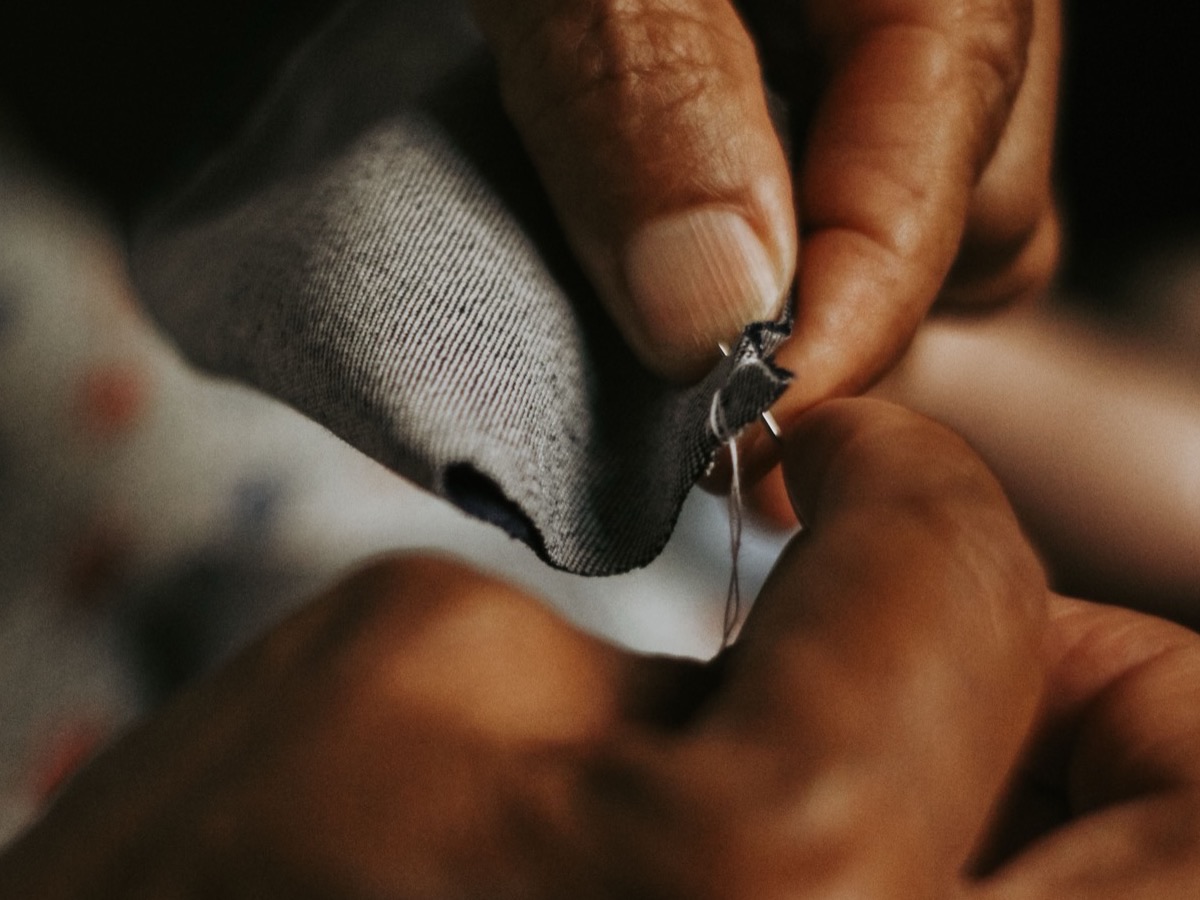
A useful repair kit contains a few needles, reliable thread and tools you can find in the dark, not a museum of notions gathered for projects you will never do.
My first sewing box was a wicker hamper with a hinged lid and enough room to hide every tool I needed. It contained six tape measures, a biscuit selection of blunt needles and thread left over from school, yet never the colour I wanted. Fetching anything meant tipping a tangle onto the table. I eventually moved the useful parts into a shallow biscuit tin. The tin closes, fits on a bookshelf and supports a button repair without the ceremony of unpacking a hobby.
Small does not have to mean flimsy. A travel-sized kit with miniature scissors too weak to cut cotton only moves the frustration to a smaller container. The aim is a short list of dependable tools that cover buttons, hems, seams and a simple darn.
Needles deserve their own parking place
Keep two or three sharps in different sizes for general hand sewing, a slightly larger embroidery needle for visible repairs and a blunt tapestry needle for knits. A needle book made from folded felt is easier to search than a loose pincushion and will not leave pins working through the tin.
Write the intended use on the fabric if you struggle to tell needles apart. The large-eyed needle I use for wool is hopeless on fine shirting, not because sewing has rules for their own sake but because it makes an unnecessarily big hole. A few threaded needles can be wound around card before a planned repair, though leaving them permanently in fabric invites rust in a damp house.
Pins are useful but not compulsory for a button. Keep them in a small separate box if the tin will travel; loose pins beneath thread cards are an unpleasant lucky dip.
Choose thread by the work, not the rainbow
Two spools of good general sewing thread, one dark and one light, handle many urgent repairs. Add black, navy and a neutral that matches most of your actual clothes if those are the colours you wear. A small skein of cotton embroidery thread or suitable darning yarn makes visible work possible without filling the tin with every shade.
Old thread that snaps under a light pull is not a saving. Test inherited supplies before relying on them in a seam. For a button on a heavy coat, use a stronger thread intended for that job; ordinary fine thread doubled many times is not an equivalent substitute merely because it occupies more space.
I store short darn left over from a project on a labelled card. There is no need to knot leftovers around the main spool, where they become impossible to unwind without scissors.
Fewer tools, each with a clear job
Small sharp scissors should cut thread cleanly to the tip. A seam ripper is helpful but needs a cover, and a blunt pencil is often better for marking than a pen that may remain on cloth. Add a short tape measure, a few safety pins, spare buttons in a paper envelope and a thimble if you use one.
A white pencil and a sliver of tailor's chalk cover dark and light fabrics. Test either in a hidden spot before drawing a long line. The tape should show both centimetres and inches if your old and new instructions use different units.
For darning, I keep a smooth wooden egg outside the tin because it is the one item that genuinely does not fit. A clean, rounded bowl or a rolled towel can support small work instead. Do not stretch a knit over a hard object with more enthusiasm than the yarn can tolerate.
Put the tin where repairs can happen
A repair kit on a high shelf behind suitcases might as well be at the shop. Mine lives beside the reference books near the dining table. A card inside the lid lists the small stock to replace: navy thread, size seven sharps, shirt buttons. When something runs out, I add it then rather than discovering the absence during a tear.
Once a month, I empty the tin onto a cloth, remove fabric lint and return bent pins to the bin rather than the felt. It takes five minutes and keeps the kit trustworthy.
The tin now comes out for ten-minute jobs because beginning is easy. Last Sunday I secured a cuff button and restitched a pocket corner without sweeping a room for equipment first. Its success is not how much it holds but how little it asks me to find.