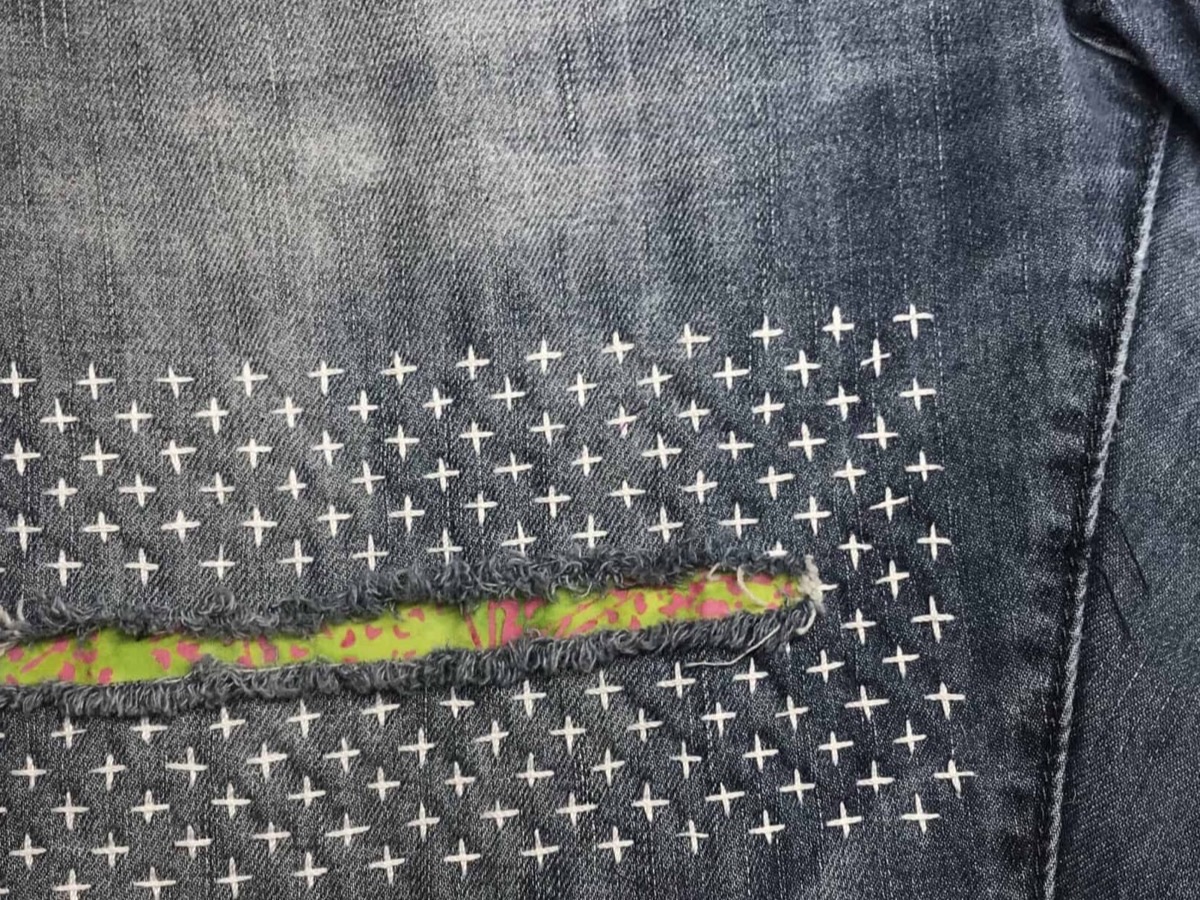
An internal denim patch and a field of running stitches can reinforce a worn knee, provided the repair reaches strong cloth and leaves room for the leg to move.
The worn place on my jeans was not yet the fashionable sort of hole. It was a soft, pale rectangle at the knee with a few broken vertical threads, the stage at which sitting on a low wall could finish the job. I wanted to keep the trousers and did not want a decorative patch riding over the outside like a postage stamp. A softer piece of old denim went inside, and simple lines of running stitch made the repair visible only in its thread.
Patching after a complete blow-out is possible too, but the preparation changes. Here, the main task was to support thinning cloth, keep the fraying contained and avoid sewing a stiff rectangle that would chafe behind the knee.
Choose a patch with compatible weight
Old jeans supply a natural patch, preferably from an area that is itself unworn. Match stretch with stretch where possible. A rigid denim patch inside very stretchy trousers can restrict movement and put renewed strain on the patch boundary. Cotton woven cloth can be kinder against the skin, but it must still be substantial enough to reinforce the area.
Wash both garment and patch first if needed. Make sure any visible repair thread can be washed under similar conditions. A bright contrasting cotton makes the running stitches legible; matching denim thread is quieter and can be worked in the same way.
Cut the patch at least two centimetres larger than the entire weak region on every side. Round the corners slightly so there are no pointed areas to lift. If the outer knee has an open hole, trim only loose threads and ragged wisps, not all fraying indiscriminately; some fibres still connect cloth to the repair.
Position from the right side
Turn the jeans inside out and centre the patch over the worn area. Pin through both layers, then turn them right side out to confirm that it really covers the whole weakness. Knees curve, so fabric that looked centred on a flat inside surface may drift after the seam and leg are smoothed.
Thread basting around the perimeter is more reliable than pins when the garment must be turned repeatedly. Use large removable stitches in a contrasting waste thread. Keep the patch flat but do not pull the underlying knee tight. I put a hand inside the leg to reproduce a little of its ordinary curve while deciding where the final edges should sit.
Where a hole is open, any separate fabric laid across the front should be arranged before stitching. For a simple inside patch, the exposed patch cloth can become part of the visible repair, with frayed garment edges secured to it gradually.
Make running stitches into strong cloth
Use a comfortable embroidery needle, a thimble if needed and a thread length that does not knot every few minutes. Begin in sound denim beyond the wear, anchoring the thread with a few small backward stitches concealed in the dense weave.
Work straight lines across the patch and worn area, taking small, fairly even running stitches. The lines can be spaced a finger's width apart or closer if the cloth is fragile. Over the hole, stitches join remaining denim to the patch; beyond it, they hold robust fabric rather than simply perforating a weak border.
Continue the grid in the other direction only if it adds useful support. There is no obligation to fill every possible millimetre. Too many closely stitched lines make an inflexible board. My first knee repair had nearly two hundred perfect little stitches and all the softness of a wallet.
Finish for movement and washing
Knot securely on the inside, weave the tail through several existing stitches and clip close. Smooth any knots away from places that will rub directly against the knee. Check the patch perimeter again after trying the trousers on, before removing the basting.
Bend, sit and walk a few steps. The patch should move with the leg, not pull at one corner or draw the outer fabric into a pucker. If it does, inspect which boundary line is too tight rather than adding more thread. Early adjustment is easier.
Wash gently at first, then inspect the edges once dry. A little fraying can be caught in a later line of stitching. After several months, my knee's blue patch shows softly through the pale wear and the rows remain visible but quiet. The repair is stronger for reaching healthy denim, not for being the densest thing in the wardrobe.